
 Credit Building
Build US Credit. No SSN Required.
ECI, FDAP, ITIN, Form 5472, tax treaties—the US tax code wasn’t written for international entrepreneurs. We translate it into a clear strategy that keeps you compliant and minimizes your tax burden.


 Licensed CPA
 50+ Countries
 No SSN Needed
The Credit Catch-22 for Non-Residents
Understanding why building US credit is hard—and how to break the cycle—is the first step to financial leverage.

No SSN = No Credit Score
The US credit system is built on Social Security Numbers. Without one, you’re invisible to credit bureaus—even if your business generates millions in revenue.

Penalties Are Automatic and Severe
Most ‘business’ credit cards (Chase Ink, Amex Gold) require a personal guarantee. They check your FICO score—which you don’t have without an SSN or ITIN.

The Solution: Build Business Credit First
You can build business credit using your EIN and D-U-N-S number—no SSN required. Then bridge to premium cards with an ITIN. This is the ‘Foreign Founder Credit Stack.’
 Understanding the System
Personal Credit vs. Business Credit
Two separate credit systems exist in the US. Understanding how they interact is critical for non-residents.

Business Credit
Linked to your EIN

Identity: Linked to your EIN number

Bureaus: Dun & Bradstreet, Experian Business, Equifax Business

How it grows: Paying vendors (net-30) and corporate cards on time

Goal: Paydex score of 80+ (Dun & Bradstreet)
 No SSN required — build this first as a non-resident

Personal Credit
Linked to your SSN or ITIN

Identity: Linked to your SSN or ITIN

Bureaus: Experian, TransUnion, Equifax (Consumer)

How it grows: Credit cards, mortgages, auto loans, authorized user

Goal: FICO score of 700+ for premium card approval
 No SSN required — build this first as a non-resident
 Credit Scores
The 3 Business Credit Bureaus You Need to Know
Unlike personal credit (FICO), business credit is tracked by three separate bureaus with different scoring models.
Dun & Bradstreet
Paydex Score
Score Range
0–100
Target Score
80+
Measures:
Payment history relative to terms
How to Check:
D&B iUpdate (free)
Experian Business
Intelliscore Plus
Score Range
1–100
Target Score
76+
Measures:
Payment trends, credit utilization, company age
How to Check:
Nav.com (free basic)
Equifax Business
Business Credit Risk Score
Score Range
101–992
Target Score
500+
Measures:
Payment history, public records, demographics
How to Check:
Nav.com (free basic)
 Step 3: Secured Cards
Secured Credit Cards: Your First Real Credit Line
Deposit cash as collateral, get a credit card, and build payment history. No credit check required—perfect for non-residents starting from zero.
How Secured Cards Work

Deposit $1,000

Get $1,000 limit

Spend & pay on time

Graduate in 6–12 mo
| Card | Best For | Deposit | Reports To | Annual Fee | Graduation |
|---|---|---|---|---|---|
| Bank of America Secured Top Pick | Building History | $200–$5,000 | Experian Business | $0 | After 12 months review |
| Capital One Quicksilver Secured Top Pick | Everyday Rewards | $200–$2,500 | All 3 personal bureaus | $0 | Auto-review after 6 months |
| OpenSky Secured Visa | No Credit Check | $200–$3,000 | All 3 personal bureaus | $35 | After 6 months review |
 Step 4: Fintech Cards
No-PG Fintech Cards: Cash Balance = Approval
These modern fintech companies don’t care about your FICO score or SSN. They approve based on your US bank account balance.
Brex
Recommended
Corporate Card
Cash Required
$50,000+
Rewards
Up to 8X on select categories
Personal Guarantee
None
SSN Required
No
Pros
 No SSNo SSN neededN needed
- No personal guarantee
- High credit limits
- Premium rewards
Cons
 Aggressive account closures for small businesses
 - Not for dropshippers
- High cash requirement
Ramp
Recommended
Corporate Card
Cash Required
$75,000+
Rewards
1.5% unlimited cashback
Personal Guarantee
None
SSN Required
No
Pros
- No SSN needed
- Great expense software
- Unlimited 1.5% cashback
- Automated savings
Cons
- Higher cash requirement
- Hard to get approved early
- Limited reward flexibility
Mercury IO
Recommended
Charge Card
Cash Required
$25,000+
Rewards
1.5% cashback
Personal Guarantee
None
SSN Required
No
Pros
- Lowest cash requirement
- Seamless Mercury integration
- Daily repayment options
- No SSN needed
Cons
- Pay-in-full (charge card)
- Must bank with Mercury
- Lower limits initially
 Step 4: Fintech Cards
The Holy Grail: Chase Ink & Amex (With ITIN)
Once you have your ITIN and 6+ months of credit history, you can access the best business credit cards in the world.
 Chase Ink Business Preferred
Sign-Up Bonus
100,000 UR points ($1,500+)
Rewards
3X on travel, shipping, ads, internet
Annual Fee
$95
Requirement
ITIN + 6 months LLC history
Pro Tip
Apply in-branch if possible. Online ITIN applications may bug out. Call the reconsideration line if denied.
American Express Business Gold
Sign-Up Bonus
70,000 MR points
Rewards
4X on top 2 categories (ads, software, restaurants)
Annual Fee
$375
Requirement
ITIN or Amex Global Transfer
Pro Tip
Easiest premium card for non-residents. Use the Global Transfer hack if you have an Amex in your home country.
Capital One Venture X Business
Sign-Up Bonus
150,000 miles ($1,500+)
Rewards
2X on all purchases, 10X on hotels/car rentals
Annual Fee
$395
Requirement
ITIN + established credit history
Pro Tip
Premium travel card with Priority Pass lounge access. The $300 annual travel credit effectively reduces the fee to $95. Excellent for international founders who travel frequently.
Shortcut
The Amex Global Transfer Hack
If you have an American Express card in your home country (UK, Canada, Australia, India, etc.), you can bypass the entire credit-building process. The strategy is simple and done entirely over the phone.
1
Get a US address and proof of address (virtual mailbox or trusted contact)
2
Call Amex and tell them you are moving to the United States
3
Request a new credit card to be sent to your US address
4
Amex transfers your foreign credit history to approve you — that’s the Global Transfer
Note: Amex can also leverage your foreign credit history through NovaCredit — a service that translates international credit reports for US lenders. This is a separate pathway that some applicants find useful.
Why This Works
 Amex is one of the few issuers with a global presence — they can verify your payment history from 20+ countries
- No US credit score needed — your foreign Amex history is sufficient
- Once approved, your US Amex card starts building your US credit file immediately
Why You Got Rejected — And How to Fix It
Even with the right strategy, rejections happen. Here’s how to decode the denial letter and get approved on your next attempt.
COMMON
“Unable to Verify Identity”
Why it happens:
Your name on the application didn’t match your passport exactly, or your address is flagged as a CMRA (Commercial Mail Receiving Agency).
How to fix it:
Call the reconsideration line. Tell them: ‘I am a non-resident owner. I can upload my passport and Articles of Organization to verify my identity.’
COMMON
“Insufficient Credit History”
Why it happens:
You applied for a premium card (Chase Ink) too early—before building enough tradelines or credit history.
How to fix it:
Go back to secured cards or net-30 accounts. Wait 6 months to build history, then reapply. Don’t waste hard pulls on premature applications.
MODERATE
“High Credit Utilization”
Why it happens:
You maxed out your secured card or used more than 30% of your available credit when the statement closed.
How to fix it:
Pay off your balance in full before the statement closing date. Keep utilization below 30%—if your limit is $1,000, never carry more than $300.
MODERATE
“Too Many Recent Applications”
Why it happens:
You applied for multiple cards in a short period, triggering ‘credit seeking’ flags with issuers.
How to fix it:
Space applications 3–6 months apart. Chase has the ‘5/24 rule’—no more than 5 new cards in 24 months. Plan your applications strategically.
 Your Timeline
12-Month Credit Building Roadmap
Building US credit is a marathon, not a sprint. Here’s what to focus on each quarter.
Month 1–2
Foundation
- Confirm EIN matches LLC name exactly
- Apply for D-U-N-S number (free)
- Open US business bank account
- Open 2–3 net-30 vendor accounts
- Make first purchases and pay immediately
Month 3–4
First Credit
- Apply for secured credit card
- Continue paying net-30
- Check D&B iUpdate for Paydex score
- Keep credit utilization below 30%
- Begin ITIN application process
Month 5–8
Growth
- Apply for fintech card (Brex/Ramp/Mercury)
- Receive ITIN from IRS
- Try Amex Global Transfer (if applicable)
- Monitor all 3 business credit bureaus
- Build 6+ months of payment history
Month 9–12
Premium
- Apply for Chase Ink Business Preferred
- Apply for Amex Business Gold
- Target $50,000+ total credit limit
- Consider authorized user strategy
- Review and optimize credit profile

 Shortcut
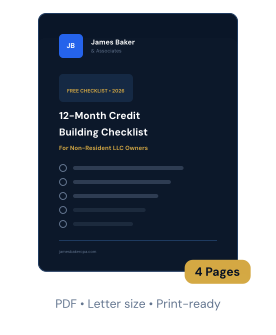
12-Month Credit Building Checklist
Get the complete step-by-step checklist as a printable PDF. Track your progress from EIN to Chase Ink approval with 31 actionable items across 4 phases.
 31 checkbox items
 Card & vendor tables
- Phase-by-phase targets
 Print-ready format
 Download Free Checklist (PDF)
No email required — instant download. 4 pages, print-friendly.
Watch: Get a U.S. Bank, Credit Card & LLC As A Non-Resident (Step by Step)

Our Process
How We Build Your Credit
Our credit building service is designed to take you from zero to $50,000+ in available credit within 12 months.
1

Credit Assessment
We review your current situation—LLC age, bank accounts, existing tradelines, and home country credit—to create a personalized strategy.
2

Foundation Setup
We set up your D-U-N-S number, open the right net-30 vendor accounts, and select the best secured card for your situation.
3
Credit Building
We guide you through each purchase, payment, and application—timing everything to maximize your credit score growth.
4

ITIN & Global Transfer
We handle your ITIN application and guide you through the Amex Global Transfer process if you have a foreign Amex card.
5

Premium Applications
When your profile is ready, we time your Chase Ink and Amex applications for maximum approval probability and sign-up bonuses.
6

Ongoing Monitoring
We monitor your business credit scores, send alerts for changes, and advise on credit optimization strategies long-term.
Why Work With a CPA for Credit Building?
Building credit as a non-resident requires specialized knowledge. Here’s how professional guidance compares.
| Credit Building Task | DIY / Online Guides | Generic CPA | James Baker & Associates |
| D-U-N-S Number Setup | ✕ Free but slow (30 days) | — May assist | ✓ Expedited setup included |
| Net-30 Vendor Strategy | ✕ Self-research | — Not offered | ✓ Curated vendor list + guidance |
| Secured Card Selection | ✕ Trial and error | — Basic advice | ✓ Matched to your situation |
| Fintech Card Applications | ✕ Self-service | — Not specialized | ✓ Application support + timing |
| ITIN Application | ✕ Complex process | —May assist | ✓ Full ITIN filing service |
| Amex Global Transfer | ✕ Self-guided | — Unfamiliar | ✓ Step-by-step assistance |
| Credit Score Monitoring | ✕ Self-managed | — Annual review | ✓ Ongoing monitoring + alerts |
| Rejection Reconsideration | ✕ No support | — Limited help | ✓ Direct reconsideration support |
| Credit Strategy Timeline | ✕ Guesswork | — Generic advice | ✓ Personalized 12-month roadmap |
| Non-Resident Expertise | ✕ US-focused resources | — Generalist | ✓ 100% international clients |
Related Service
LLC Formation & Setup
Your LLC is the foundation of your credit profile. Learn about state selection, EIN, and formation requirements.
RELATED SERVICE
US Bank Account Setup
You need a US bank account before applying for credit cards. Learn how to open one remotely as a non-resident.
RELATED SERVICE
Tax Strategy Planning
Your ITIN is key to premium credit cards. Learn about ECI, FDAP, and the ITIN application process.
Frequently Asked Questions
Common questions about building US credit as a non-resident LLC owner.
Yes. Business credit is built using your EIN (Employer Identification Number) and D-U-N-S number—neither requires an SSN. You can open net-30 vendor accounts, get secured business credit cards, and apply for fintech cards like Brex and Ramp without any Social Security Number. An ITIN is only needed later for premium cards like Chase Ink.
A D-U-N-S number is a unique nine-digit identifier issued by Dun & Bradstreet that serves as the ‘SSN for your business.’ It allows vendors and banks to report your payment history to business credit bureaus. You can get one for free at the Dun & Bradstreet website (takes about 30 days) or pay for expedited processing. Do not buy their $1,000/year ‘Credit Builder’ package—the free number is all you need.
The Paydex score is Dun & Bradstreet’s business credit score, ranging from 0 to 100. It measures how quickly you pay your bills relative to payment terms. A score of 80+ (paying on time) is considered good. Paying early can push your score even higher. You need at least 2–3 tradelines reporting to D&B to generate a Paydex score.
Net-30 vendors are suppliers that give you 30 days to pay for purchases. When you pay on time (or early), they report your payment to business credit bureaus like Dun & Bradstreet. This creates ‘tradelines’ on your business credit file. Popular net-30 vendors for new LLCs include Uline, Grainger, and CEO Creative. The goal is to establish a payment history, not to buy things you don’t need.
A secured credit card requires a cash deposit that becomes your credit limit. For example, you deposit $1,000 and receive a card with a $1,000 limit. You use the card normally, pay on time, and the bank reports positive payment history to credit bureaus. After 6–12 months of responsible use, many banks will ‘graduate’ you to an unsecured card and return your deposit.
If you have an American Express card in your home country (UK, Canada, Australia, India, etc.), you can use Amex’s ‘Global Transfer’ program to get a US Amex card. Amex uses your foreign credit history to approve you—bypassing the need for a US credit score entirely. Log into your home country Amex account, find the Global Transfer page, select United States, and provide your US LLC address and bank details.
Not for all cards. Fintech cards (Brex, Ramp, Mercury IO) and secured cards don’t require an ITIN. However, premium cards like Chase Ink Business Preferred and Amex Business Gold typically require either an SSN or ITIN because they check your personal credit. Getting an ITIN is recommended for the long-term goal of accessing the best rewards cards.
With a focused strategy: Month 1 you set up your EIN, bank account, and D-U-N-S number. By month 2–3, you open net-30 accounts and a secured card. By month 6, you can apply for fintech cards and your ITIN. By month 12, you should have $50,000+ in available credit. The key is consistency—never miss a payment and keep utilization below 30%.
Business credit is linked to your EIN and tracked by Dun & Bradstreet, Experian Business, and Equifax Business. Personal credit is linked to your SSN or ITIN and tracked by the consumer bureaus (Experian, TransUnion, Equifax). Most ‘business’ credit cards actually check your personal credit for approval, which is why non-residents need to build business credit first and then bridge to personal credit via an ITIN.
Yes. If you have a business partner or spouse who is a US resident with good credit, they can add you as an authorized user on their credit card. Their payment history for that card gets ‘cloned’ onto your credit file once you have an ITIN. This can give you a 700+ credit score immediately instead of starting from zero. American Express often allows adding authorized users without requiring an SSN.
The most common reasons are: (1) ‘Unable to verify identity’—your name didn’t match your passport exactly or your address was flagged. Call the reconsideration line with your passport and Articles of Organization. (2) ‘Insufficient credit history’—you applied too early. Build more tradelines first. (3) ‘High utilization’—you used too much of your available credit. Keep it below 30%.
No. Buying an ‘aged’ LLC (shelf company) is often a scam or highly risky. Banks flag these accounts for fraud because the ownership change is visible. It’s cheaper and safer to build your own credit history from scratch. With the right strategy, you can have solid business credit in 6 months—without the legal and financial risks of a shelf company.

Start Building Your US Credit Today
Schedule a free consultation with James Baker, CPA. We’ll assess your current situation, create a personalized credit roadmap, and guide you through every step—from D-U-N-S number to Chase Ink approval.
 Licensed CPA
- 15+ Years Experience
- 50+ Countries Served